Notes from the bench
Handling guidance, analytical method explainers and sourcing standards — written for the people who actually pipette.
How to actually read a certificate of analysis
A COA is only useful if you know which numbers matter. Here is what each section on a peptide certificate is telling you — and the three things people most often misread.
photo Infographic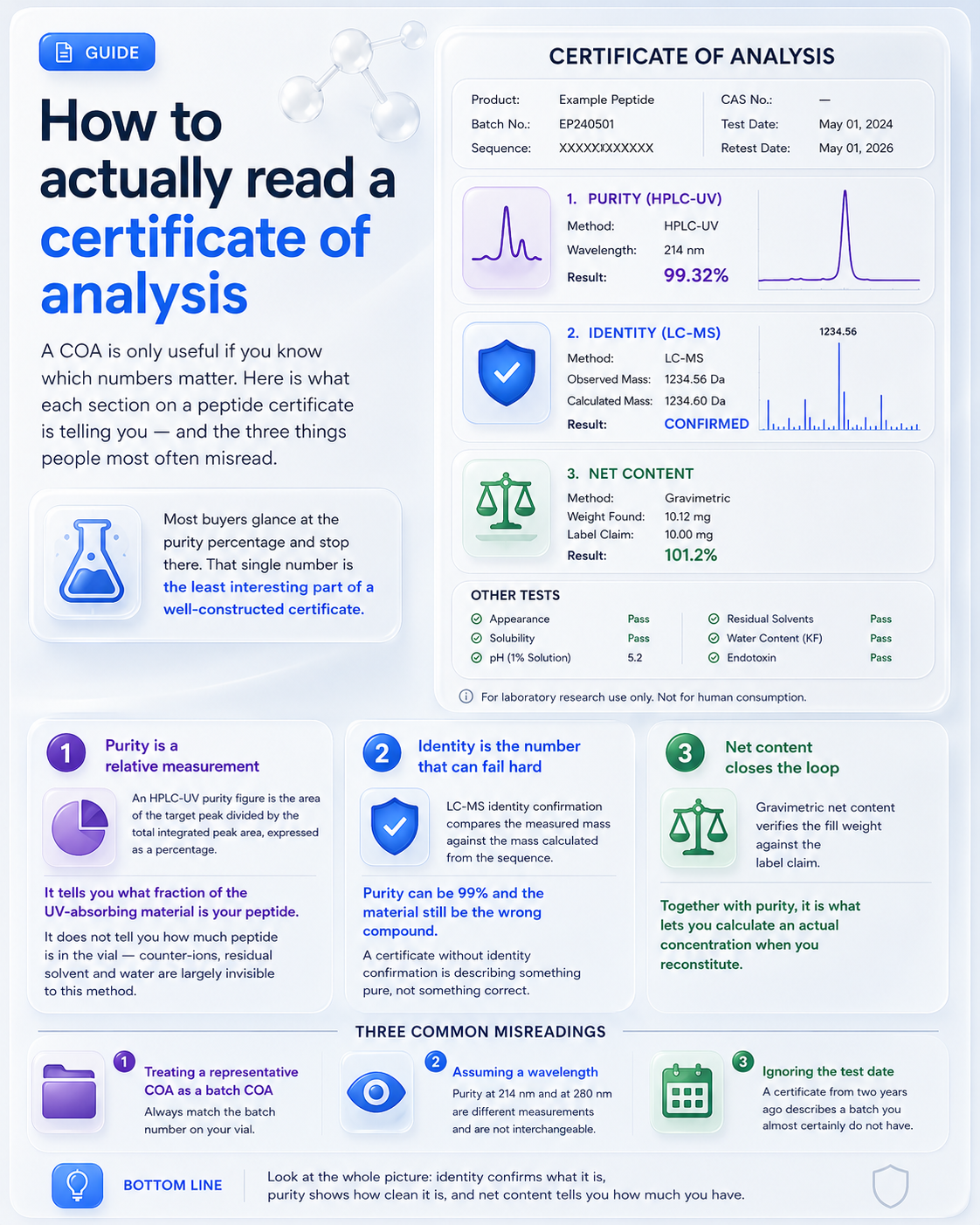
HPLC-UV and LC-MS answer different questions
Purity and identity are not the same property, and the two methods that measure them are not substitutes for one another.
split InfographicReconstitution practices that preserve your sequence
Shearing, oxidation and adsorptive loss all happen at the bench, after the material leaves our hands. A few habits prevent most of it.
steps InfographicStorage, stability and what -20°C actually buys you
Lyophilised peptides are far more robust than people assume in transit, and far more fragile than people assume in solution.
metrics InfographicWhy batch-level COAs, not representative ones
A representative certificate describes a batch someone once made. It says nothing verifiable about the vial in your hand.
stats InfographicWhat 'research use only' actually obliges you to do
The phrase is not marketing boilerplate. It describes a real and enforceable boundary on how these materials may be used.
split Infographic